Synthesis Theory I: Final Exam
You may use any inanimate resource for this final, except a
resource generated by another student during the semester such as their
class notebook. Your exalted instructor is the only human you may
communicate with about this exam until it is done. The exam is due by 10
a.m. sharp in room 316C next Friday. The exam may not be turned
in late.
- Soundfiles: If a soundfile is sampled at 44.1 kHz, and the
soundfile is stereo and each sample is two byte (or 4 bytes for
each stereo pair), then how many bytes of sound data are there
in one second of sound? How many bytes are there in one minute
of sound? In an hour?
- Extra Credit: If an audio CDROM can hold 650 MB of stereo
audio at a sampling rate of 44.1 kHz, and each sample is two bytes
(i.e., 4 bytes for each stereo sample pair), how many seconds
of audio can be stored on an audio CD? How many minutes is that?
- Soundfiles (2): What is this: 0xff and what does it mean?
- Wavetables: If a soundfile is stored in a wave table and played
back with a wavetable increment of 1, then each sample is played back
and the resulting sound is the same as the original recording. If the
wavetable increment is 2, then the resulting sound will be an octave
higher because every other sample in the wave table is skipped.
What is the wavetable increment if you want the resulting sound to be
a perfect fifth above the original sound?
- Wavetables (2): Suppose you have a wavetable with 1000 samples.
Now suppose you have just played sample 363 in the wavetable and you are
playing the wave table with an increment of 1.2. Then the next sample you
will have to play is 364.2. But you only have the sound sample for 364
and 365. What are you going to do? Name the two simplest interpolation
methods used to deal with this problem.
- Filter types: What is the difference between a linear and
nonlinear filter? In other words, how does each type of filter
affect the frequencies of the input signal?
- Filter types (2): Name two linear filters we covered in class.
Name two non-linear filters we covered in class.
- Linear filters: What are the three mathematical operations which
can be done on a signal in a linear filter?
- Linear filters (2): Draw the flow-graph schematic of a generalized
linear filter.
- Reverberation: Is reverberation a linear or non-linear filter? Why?
- Filters: Explain these terms: "flowgraph", "difference equation",
"transfer function", "frequency response", "pole-zero diagram".
How do these terms relate to filters? How do these terms relate to
each other? Only a top-level (i.e., vague) description is necessary,
and no mathematics are involved in the explanation.
- Extra Credit: If you were to implement a filter in a graphical
environment such as Max/MSP, which of the terms in the previous question
are relevant? If you were to implement a filter directly in C, which
of the terms in the previous question would be relevant?
- Filters: What is the difference equation for the averaging filter (a
filter which takes the current sample and the last sample and outputs the
average of the two samples)? Draw the spectrum for the averaging filter.
- Extra Credit: Draw the pole-zero diagram for the averaging filter.
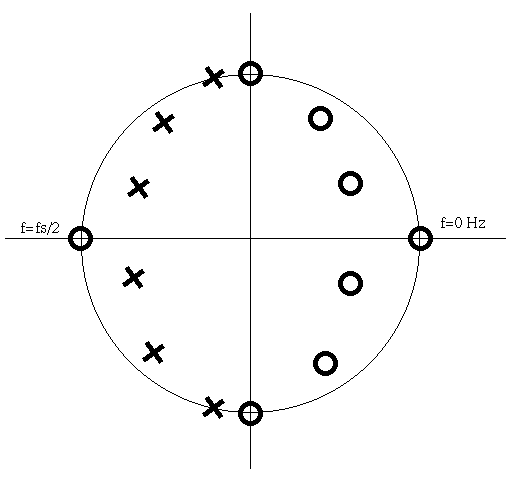
- Pole-Zero Diagram: Draw the qualitative (approximate) spectrum (from
0 Hz to half the sampling rate) for the following pole-zero diagram:
- Sinewaves and Hearing: What is the mathematical equation for
a sinusoid? What are the three physical variables in the equation?
How does these three variables relate to hearing?
- Sinewaves and Mathematics: What is the mathematical definition
of a complex sinusoid?
- Spectrum: What are the TWO steps that must be done to measure
the amplitude of a sinusoid in an audio signal?
- Spectrum (2): How can the amplitude of a sinusoid with an
arbitrary phase be measured in an audio signal?
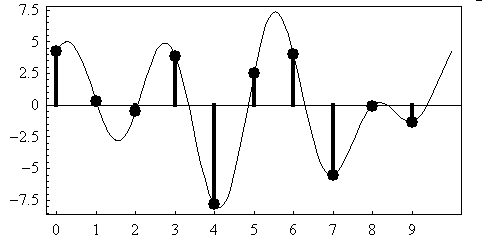
- Spectrum (3): Here is an audio signal:
sample:  1     2      3     4      5     6     7      8      9     10
signal:  4.28, 0.34, -0.48, 3.91, -7.82, 2.55, 4.06, -5.50, -0.03, -1.30
Here is a picture of the signal (which repeats to the left and the
right):
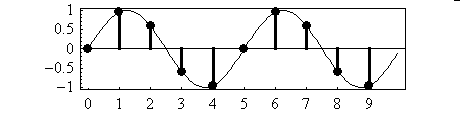
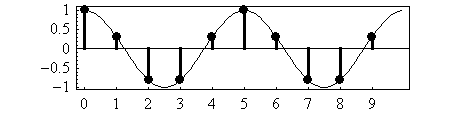
 And here is a test sinewave, and a test cosinewave:
sample:  1    2      3      4      5     6    7      8      9     10
sine:    0,   0.95,  0.59, -0.59, -0.95, 0,   0.95,  0.59, -0.59, -0.95
cosine:  1,   0.31, -0.81, -0.81,  0.31, 1,   0.31, -0.81, -0.81,  0.31
Here is a picture of the test sinewave:
Here is a picture of the test cosinewave:
 (A) What is the amplitude of the test sinewave present in the signal?
(B) What is the amplitude of the test sinewave present in the signal?
(C) What is the amplitude of the sinusoid in the audio signal which
has the same frequency as the test sine and cosine?
(The normalization factor will be 5, so divided by 5 to find the
final amplitude of the sinusoids, or don't worry about normalization).
(A) What is the amplitude of the test sinewave present in the signal?
(B) What is the amplitude of the test sinewave present in the signal?
(C) What is the amplitude of the sinusoid in the audio signal which
has the same frequency as the test sine and cosine?
(The normalization factor will be 5, so divided by 5 to find the
final amplitude of the sinusoids, or don't worry about normalization).
- Extra Credit: What is the phase of the sinusoid in the signal
in the previous question which you just calculated the amplitude of?
- Ring modulation: If the input signal into a ring modulator is
a 500 Hz sinewave and the modulator is a 60 Hz sinewave, what are the
output frequencies of the ring modulation that you will hear?
- FM Modulation: What is the mathematical equation for FM
Synthesis? What are the interesting control variables in the
equation?
- FM Modulation (2): If the carrier is 400 Hz, and the modulator is 100
Hz, and the index of modulation is 3, what is the pitch of the resulting
sound? Listen to the output of your lab program if you don't know.
- Wavelength and Frequency: You thought you would never see
question like this again, but... Bats (depending on the species) can hear
up to 150 kHz. What is the size of the smallest bug a bat can catch?
Assume that they are using 100 kHz to echolocate their prey, and it
takes 3 wavelengths of that frequency to detect reflections of the
sound off of the bug, and the speed of sound in air is 350 meters/sec.
- Extra Credit: Why do I say that the bat's prey must be 3 times
bigger than the detecting frequency? Larger bats use lower
frequencies than smaller bats for finding prey, why might that be
a reasonable situation?
|